
How Successful Local Businesses Get Quality, Organic Traffic Without The Guesswork Or Wasting Time ... And It Will Work For You Too!
If you are not attracting the right customers and traffic to your business ... start using the same powerful strategy that big companies like Amazon, Walmart, and eBay use to drive buyers directly to their businesses.
- Reach buyers who are actively searching for the products and services you offer right now.
- Gain long-term, sustainable traffic growth, with initial exposure coming within 30 days.
- Establish your business in key areas that your competitors overlook through a tailored, done-for-you method, while also improving your online reputation to further increase sales.
And yes, this proven traffic strategy works really well for local businesses with physical locations.
If you’re an online local business, it works like gangbusters, too, if you want to expand your business nationally.
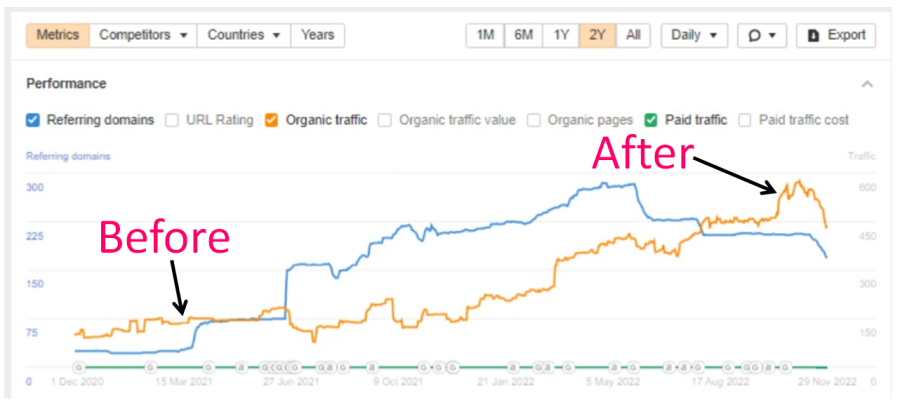
Here are the results for one of our clients.
Let me explain how ...
We’ve been helping local businesses generate consistent traffic and sales with our Done-For-You (DFY) Hyper-Local Campaigns.
These campaigns have attracted high-quality leads and increased revenue for businesses across a range of niches, from dental practices, veterinarians, and chiropractors to storage facilities and home improvement services.
With this model, we help our clients achieve:
- High visibility in key markets, with targeted exposure within 30 days ...
- Long-term and sustainable traffic growth in areas that competitors overlook ...
- A significant boost in online reputation, which directly leads to increased sales ...
Not because of daily social media posting … not because of cold outreach … and not because of expensive paid advertising.
But ALL because of our high-impact CRD Strategy—a proprietary method that drives organic traffic by creating, repurposing, and distributing high-impact content across the web.
This SAME model has helped take businesses from $100k to $500k.
From $500k to $5M … and from $5M to $10M+.
This SAME approach helped grow:
- A luxury or design business with high-quality leads. Like Edward (see below).
- A healthcare practice by increasing capacity and doubling revenue. Like Kam (see below).
- A multi-location business with organic traffic and high visibility on Google. Like Peter (see below).
- A new entertainment website gain organic traffic and authority on Google. Like Kay (see below).
- An online medical device brand that was struggling with sales (from $48,000 monthly sales to $735,000). (see below).
- A dental clinic that was experiencing a competitive local market doubled their patient count within months (see below).
- A small boutique winery achieve breakthrough revenues in a highly competitive regional wine market. (see below).
- A home robotics company compete with giants like Amazon.com and achieve increasing national online visibility and revenues. Like Max (see below).
“Your expert campaigns transformed our luxury business!”
Edward got high-quality leads for his luxury/design build business and doubled his annual revenue (an additional six figures).

Edward, Manager
“Your DFY campaigns catapulted our business to new heights!”
Kam went from one bed at half capacity to 3 beds at near full capacity. He doubled his annual revenue (an additional six figures).

Kam, Physiotherapist
“Thanks to your done-for-you campaigns, we flourish across multiple locations!”
Peter got his time back so he can focus on being the CEO instead of working in his business. His business receives organic traffic from having high visibility in Google.

Peter, Business owner
“I can’t thank you enough for helping me build organic traffic to my once-struggling business!”
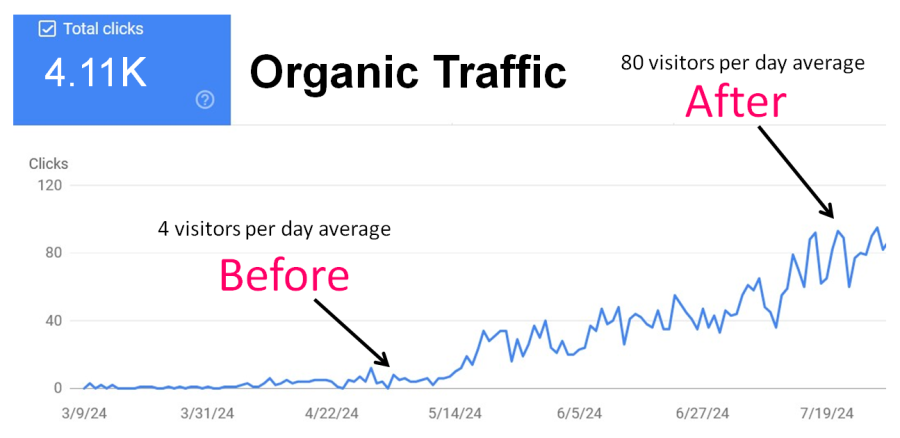
As shown below, within a few months, Kay 20x her daily organic traffic to her new entertainment website from an average of 4 visitors per day to 80 visitors per day.
Her site also gained brand authority and trust of Google within 2 months.
In one year, an online medical device brand increased traffic by approximately 20,000%, taking their monthly sales from $48,000 to $735,000—a staggering $8,300,000 increase in yearly sales.
As shown below, the campaigns generated impressive growth in organic traffic.
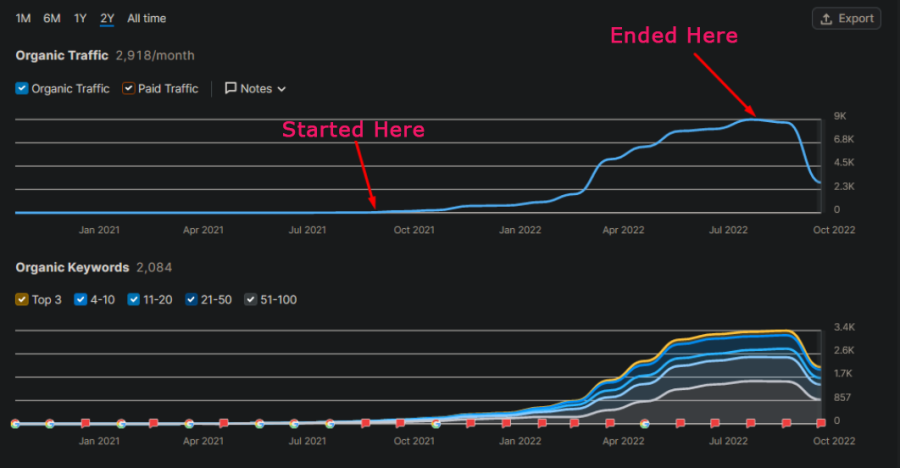
A dental clinic doubled its organic traffic and significantly improved its presence on page 1 of Google with roughly 100-350 keyword combinations. The dental clinic saw a dramatic improvement in online mentions, traffic, and more patients coming through its doors.
As shown below, the campaigns started in February 2000 and doubled organic traffic within a few months.
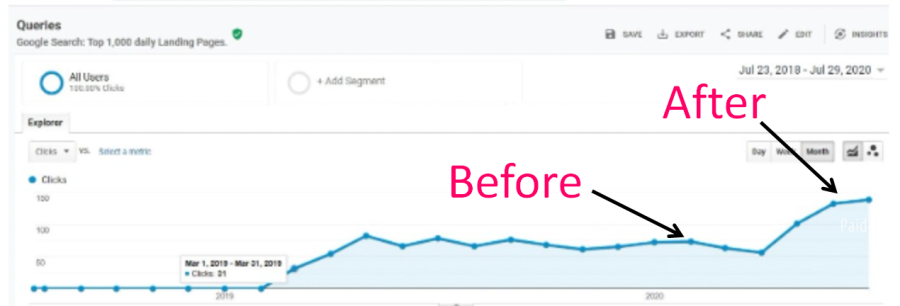
In just 21 months, this boutique winery store saw at least a 10-fold increase in organic traffic overall hitting 45,000 visitors per year, up from just around 4,800 visitors per year.
As shown below, when the campaigns began in September 2019, the traffic was at 405 organic visitors per month. By June 2021, organic traffic was at about 4,251 visitors per month. That’s a significant boost that helped to put the winery on the map.
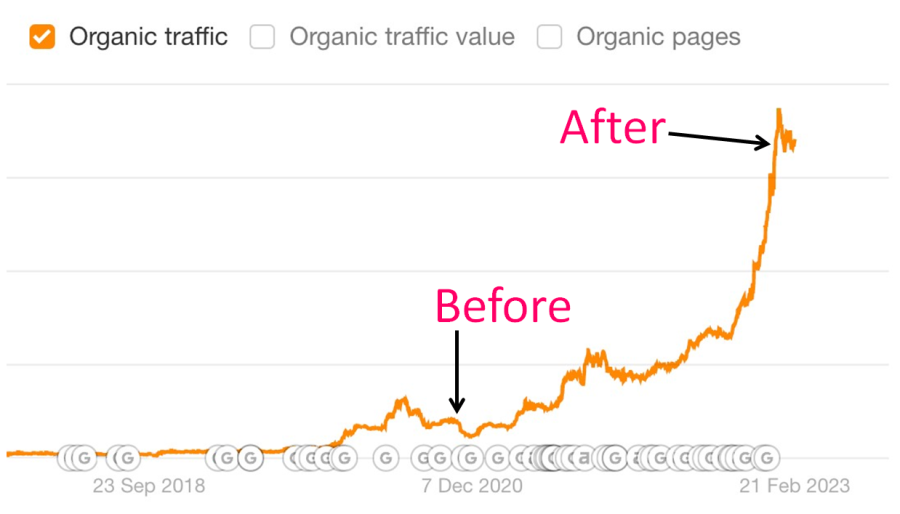
Max employed campaigns for his online robotics retail store to compete against giants like Amazon.com.
As shown below, he achieved an impressive 195% increase in organic traffic to his website over 9-10 months. The website now ranks on the first page of Google for many competitive keywords, giving it a strong presence in the market.
Our campaigns ONLY work for businesses ready to establish a strong local presence or online presence and have a product or service that can stand out in their market.
If you still do not have a product or service that can stand out, then our service might not be the right fit at this time.
Now, if you: (1) have a great product or service, (2) are ready to take on more customers or patients, and (3) will be able to look after those new customers or patients …
… then pay close attention to every word on this page.
Our CRD Strategy solves 3 BIG problems for local businesses trying to grow:
"I need more consistent and predictable traffic."
Is your business relying on inconsistent traffic sources like referrals, cold emails, or social media posts that are NOT delivering reliable results?
The Solution: Our CRD Strategy consistently sends highly targeted traffic, delivering a steady stream of potential customers.
"I need better or more qualified leads."
Do you have an online presence but struggle to attract quality leads? Do you need better leads who are a good fit for your offer or service?
The Solution: Our CRD Strategy pre-educates potential clients on your offer, ensuring only the most qualified leads come through.
"I don’t have time to do all these online marketing stuff every day."
Are you confident that all your online marketing efforts will bear results? Are you making less than what you expected and are sick of the content grind? Don’t have time to create new content every day to post on social media, run your business, and spend time with your family?
The Solution: Our CRD Strategy clearly articulates the problem you solve and the product you offer to increase buyer intent. Our DFY campaigns handle all the heavy lifting, freeing you from all the guesswork, content creation, and the daily boring marketing grind—so you can focus on running your business.
All you need is our CRD Strategy.
With our approach, marketing becomes a lot less complex, stress-free, and less time-consuming.
All you have to do is provide us with some key information and leave the rest of the work to me and my team. Just give us 30 minutes to 1 hour of your time, and we’ll take care of everything.
We’ll spare you all the headaches and wasted time figuring out how to make things work.
You can then focus on what you do best—providing your service to your patients or customers.
That’s time well spent for you. Just leave all the grunt work to us. That’s what we specialize in.
The CRD Strategy Difference
❌ The Old Way
- Spend countless hours creating and posting content on social media platforms like Facebook, Instagram, and YouTube, without a clear strategy for converting leads into customers.
- Waste money on ineffective paid ads, hoping they reach the right audience but often missing the mark due to poor targeting and engagement.
- Try to manage multiple marketing channels without the expertise or media connections needed to establish credibility and authority in your industry.
- Rely on outdated organic traffic tactics and hope for long-term gains, which can take months or years to deliver measurable results.
- Guess what type of content will resonate with your audience, leading to inconsistent traffic, low engagement, and unqualified leads.
- Struggle to build trust and credibility without being featured on authoritative platforms or media outlets.
- Spend valuable time trying to figure out content distribution across multiple channels, leading to inefficient use of resources and lost opportunities for growth.
- Experience frustration from juggling too many marketing tasks while still trying to run your core business, leaving you feeling overwhelmed and stretched thin.
✔️ The 95box Way
- Expertly crafted, targeted content. At 95box, we don’t just create content—we create it with purpose. Our team of professionals ensures your content is designed to convert, so you won’t waste time posting endlessly on various online platforms with no results. We do all the heavy lifting for you.
- No wasted ad spend. Instead of pouring money into ineffective ads, we focus on organic traffic that comes from content distributed across high-authority platforms. Our campaigns ensure your business is seen by the right audience, eliminating the need for guesswork and wasted advertising dollars.
- Leverage expert marketing and media connections. Unlike trying to manage everything yourself, 95box utilizes a team of content creators, developers, and advertising professionals who have years of experience and established media connections. You’ll benefit from exposure on high-traffic platforms that build your credibility and authority quickly.
- Sustainable growth with faster results. No more waiting months or years for organic traffic results that may or may not happen. Our CRD Strategy (Create, Repurpose, Distribute) accelerates your visibility and traffic while still ensuring long-term growth. You’ll see results in weeks, not years.
- Data-driven content creation. We don’t guess what will work. Our CRD Strategy is rooted in understanding your audience’s search behavior and preferences, ensuring your content resonates with them, which leads to higher engagement and more qualified leads.
- Establish instant credibility. Instead of struggling to build trust slowly, we get your business featured in top-tier publications, news outlets, and authoritative platforms. This instant credibility boosts your online presence and customer trust, setting you apart from the competition.
- Efficient multi-channel distribution. We handle content creation, repurposing, and distribution across hundreds of high-authority sites, news outlets, and niche platforms. This widespread distribution ensures your message reaches the right audience without you having to spend valuable time figuring out the best channels.
- Simplified marketing, more time for your business. Instead of juggling endless marketing tasks, let us take the burden off your shoulders. We handle all the complexities of online marketing, allowing you to focus on what you do best—running your business and serving your customers.
95box is not just another digital agency. We’re a collective of diverse experts, including content creators, developers, and advertising professionals, all working together to drive your success.
Here’s what we’ll do for you—at a fraction of the cost and man-hours it would take for you or your team to figure out and implement this strategy on your own.
More importantly, we have solid media relationships that have been built through the years. Not everyone has this kind of access. Now you can benefit from all these exclusive partnerships that we have.
DFY Hyper-Local Campaigns
We deliver comprehensive campaigns tailored specifically to your business. By featuring your brand in major publications, we enhance your brand’s authority and attract more clients.

Leverage Media Connections
Our extensive media connections and exclusive partnerships allow us to gain visibility for your business in top-tier outlets, attracting new clients in a stress-free, yet highly profitable manner.

Sustainable Organic Growth
We focus on long-term success, using strategies that drive sustainable growth. Our approach ensures that your online presence continues to thrive and grow, far beyond the initial campaign.
The Secret Sauce to building organic traffic: Create, Repurpose, & Distribute
At the core of our service is our CRD Strategy—a method that’s both innovative and effective in driving organic traffic and establishing your brand as a leader in your industry.
Here’s how we make this work for any local business:

Create
We start by diving deep into your business, uncovering your unique value proposition. We then create content that not only resonates with your audience but also aligns perfectly with their search intent.

Repurpose
This is where the magic happens. We take that content and transform it into multiple formats—articles, videos, infographics, audio ads, blog posts, and slide shows. This multi-format approach ensures your message reaches a wide audience, catering to different content consumption preferences.

Distribute
At the core of our secret sauce is our distribution network. We use our extensive connections with over 300 high-authority sites, news outlets, and niche platforms to publish your content across the web. This widespread distribution amplifies your online visibility, making it impossible for Google—and potential customers—to ignore your business.
Imagine this ...
With our unique CRD Strategy, your business’s visibility will soar. Picture your competitors watching in disbelief as your online presence outshines theirs, your content appearing everywhere they look.
They’ll wonder how you did it, but only you will know the secret weapon behind your success.
Our specialty lies in helping you grow your organic traffic, all done for you, so you can connect with people who are actively searching for your solution.
Yes, it's content marketing, BUT Better.
At 95box, we don’t just create content—we make sure it gets seen by the right audience, at the right time, and in the right places.
Our expert team publishes your content across hundreds of platforms, including high-authority blogs, news outlets, and social media channels. This multi-channel approach not only drives more organic traffic but also significantly expands your brand’s reach and reputation.
Your business will get featured on top media platforms ...
With our extensive media connections, your business can be featured on some of the world’s most influential media platforms.
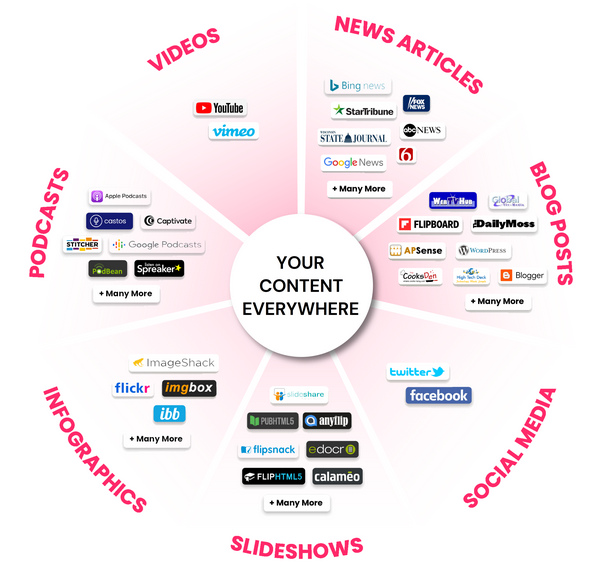
- We establish your brand’s authority by getting articles published on respected business news sites.
- We'll get you presence on blogs, infographics sites, slide show sites, and other popular online platforms.
- We engage your target audience through carefully crafted audio and video content that connects with your target audience.
... which will attract people who are ready to buy.
Did you know that 99.5% of shoppers research purchases online at least sometimes, with nearly 87% doing so regularly or always?*
This behavior has become increasingly common across various local service business or product categories. Studies also show that consumers use search engines, news articles, and other online platforms before buying both online and in physical locations.
Additional research shows that 72% of consumers prefer to learn about a brand through content rather than traditional ads.
We dig deep to understand what your potential customers are searching for. Then, we create and publish content all over the internet, making it easy for them to find—and choose—your products or services.
We'll build brand authority & trust for you ...
The more your brand is mentioned by people, businesses, and popular websites, the more trust you build with your target market and search engines like Google.
- This increased trust will boost your local online presence and reputation.
- More importantly, this leads directly to more sales and empowers you to command the prices your products or services truly deserve.
Our strategies are meticulously designed to build your brand authority and trust at scale, ensuring your business becomes the preferred choice for your audience.
... and scale your organic traffic and revenues.
The more content you publish about your products, the more sales you can generate.
There are thousands of topics and queries related to your products that you might not be showing up for yet.
With 95box, you can increase your visibility and traffic by scaling content that effectively highlights your services and offerings, thereby resulting in revenue growth.
DISCLAIMER: I have to be upfront … results like the ones mentioned are not typical for every business. We’ve spent years refining our approach and building strong media connections to deliver these kinds of outcomes. While many businesses see growth within the first few months, most start by increasing traffic steadily before scaling up over time as visibility and reputation improve. Every business is different, and results will depend on your unique market and commitment to the strategy.
It's time for you to get your best converting organic traffic.
If you’d like to bring in more of your best customers every month to increase your revenues … you have two options:
Option 1
Take the blueprint I laid out here, copy our CRD Strategy, and give it a go on your own. Various resources are available for you to use, but I cannot vouch that you will achieve the same results.
Plus if you have the time and resources to do this on the side, feel free to give it a go.
Option 2
You can work one-on-one with me and my team and let us do what we do best.
We’ve created an effective and efficient system of doing things and leveraging the media connections that we’ve built through the years.
Once we’ve set things up, it will be completely hands-off on your part so that you can focus and spend more time on what you enjoy and do best.
Here's what you get from our service:

Benefit From Long Term Organic Traffic Strategies That Work
Our methods are built for sustained growth, ensuring your business continues to thrive over
Get Results While You Focus On Running Your Business
We handle the heavy lifting, allowing you to focus on what you do best.

Get Seen In Places Your Competition Are Not
We target overlooked niches and platforms to give you a competitive advantage in the market.

Get Ultra Specific Content That Attracts Ideal Customers Looking For What You Sell
We create ultra-specific content that resonates with your target audience and drives conversions.
Receive More Local Traffic From Google Maps
We optimize your local presence to attract more customers from your area.

Increase Trust & Credibility So That More People Choose To Spend Money With You
We boost your brand’s reputation, leading to increased sales and fostering long-term customer loyalty.
Due to capacity, we ONLY have 15 available customer slots left.
To maintain our unwavering commitment to service excellence and ensure we can leverage our media connections to their fullest potential, we are ONLY accepting 15 8 clients now.
Once we have reached full capacity, we are shutting down this offer. I also cannot guarantee that our prices will remain at this level next time we decide to open up again.
This exclusive approach allows us to work closely with each business, delivering unparalleled results and the personalized attention you deserve.
When you join our select group, you’re not just getting a service—you’re gaining a dedicated partner invested in your success.
If you’re a business owner focused on long-term growth and want to see results within 30 days—without diverting countless hours from what you do best—this is the perfect solution for you.
However, if you’re searching for a quick fix or are hesitant to invest in a comprehensive strategy, this might not be the best fit.
Now, if you’re serious about taking your business to the next level and want a partner who is as dedicated to your success as you are, we’d love to work with you.
Take the next step toward transforming your business. Click below to learn more and get started.
Learn more details, see client reviews, explore pricing, and discover how our strategy can start driving more traffic and sales for your business.

If you’re serious about growing your business and want to see results within 30 days without sacrificing your time or focus, we’re here to help. We only have 15 8 client spots remaining, so don’t miss out.
Click below to learn more, see client reviews, explore pricing, and get started on transforming your business.

Frequently Asked Questions
Will this work for local businesses?
Absolutely! In fact, local businesses often see some of the most dramatic results. It’s a true benefit for transforming local presences. Our strategy helps you stand out in your community and even expand your reach to nearby areas if you want.
Will this work for family-run online businesses?
Definitely! This works for online businesses of any size, including family-run operations. We tailor the approach to help you grow organically and expand your market nationally.
Can this help me make more sales?
Yes. The beauty of this method is that people are already searching for what you have, and this is just about getting in front of them at the right time.
How quickly can I see results?
Exposure can start happening in 7-10 days and you could start seeing noticeable results in traffic within the first 30-90 days, but this is also about long term ongoing free organic traffic growth.
Do I need to provide the content, or do you handle everything?
We handle everything for you. From content creation to distribution, our team takes care of the entire process. You just need to provide us with key information about your business, and we’ll do the rest.
Is this strategy suitable for all industries, or just specific types of businesses?
Our strategy is highly adaptable and works across a wide range of industries. As long as your business has a unique value proposition, we can help you grow your traffic and customer base.
How does this impact my overall online presence?
Beyond traffic, you’ll see improvements across the board – from brand awareness to customer trust. This ultimately leads to more sales for your business.
What is the traffic source and how does it work?
Click the “Learn More Details” button below for more details, customer reviews, pricing, and a more detailed breakdown of the strategy.
If you have any questions, email: support [@] 95box.com
*Source: Survey: The Ever-Growing Power of Reviews, "Impact consumer behavior throughout the purchase journey, based on research of more than 8,000 U.S. shoppers", PowerReviews.com, April 2023